Tell us about the job
Takes about a minute. No obligation.
A furnace installation in this county starts with a contractor sizing the equipment to what the structure actually needs and what the local climate actually delivers. 87 severe weather events were recorded in Chickasaw County, Iowa between 2015 and 2024. That puts severe weather in this area at a moderate level, which means a contractor here factors weather load into the selection without designing around a punishing baseline. Duct routing, heat loss calculations, and equipment capacity are the variables that decide how well a new furnace handles a Chickasaw County winter, and those are local judgments a contractor makes after looking at the house.
Ductwork sized and routed for an older system carries assumptions that a new furnace will test. Half the homes in Chickasaw County, Iowa were built in 1966 or earlier (2020-2024 ACS 5-year). When that much of the housing was built well before current equipment became standard, the duct layout a contractor finds behind the walls often reflects a different set of load calculations entirely. Whether those ducts can move air the way a new furnace needs them to is something a contractor measures on site, and the answer changes the scope and the cost of the install before the unit itself is ever priced.
What Gets Installed With a New Furnace
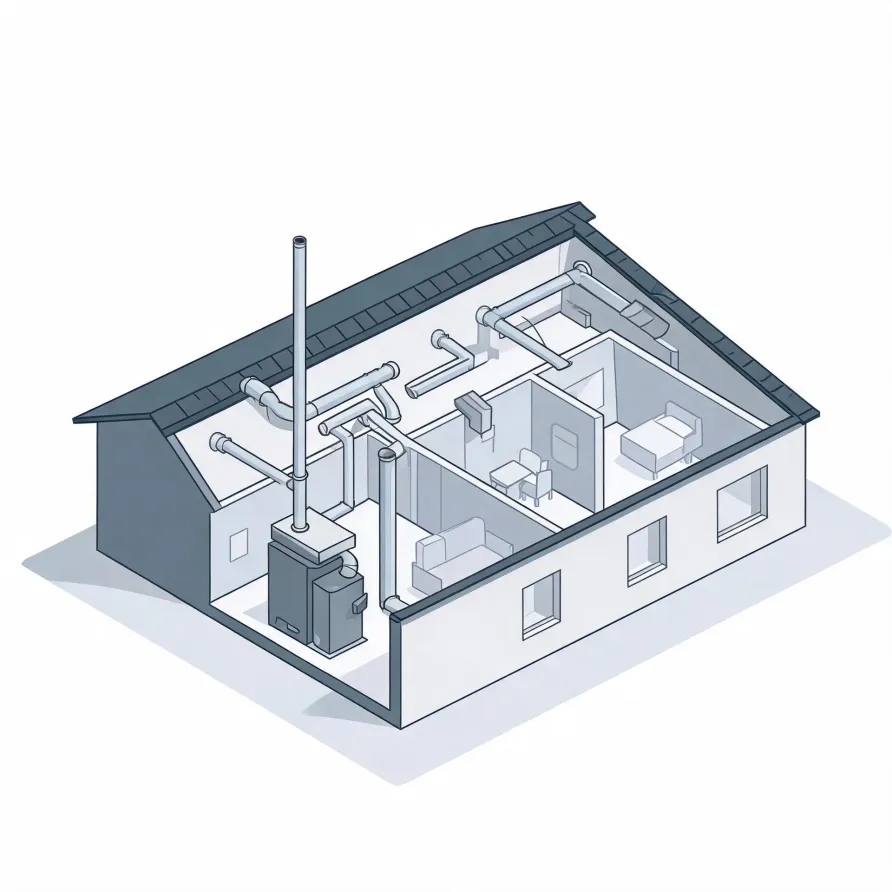
The furnace itself sits in a utility space, a basement, or a mechanical closet, and it is the unit that produces the heat. A contractor mounts the air handler directly to it or nearby, and together they form the core of the system. A flue pipe runs from the furnace to an exterior wall or the roof to carry exhaust out of the house.
A thermostat goes on an interior wall where it reads the air temperature of the living space and signals the furnace when to run. The contractor also installs or connects a filter housing at the air intake point, which is where incoming air gets cleaned before it moves through the system.
The drawing shows a standard layout, and a licensed contractor determines exactly what applies to your house.
Get matched in Chickasaw CountyChickasaw County, Iowa, by the numbers
87 severe weather events were recorded in Chickasaw County, Iowa between 2015 and 2024.
NOAA National Centers for Environmental Information, Storm Events Database, bulk CSV export, events 2015-01-01 through 2024-12-31.Half the homes in Chickasaw County, Iowa were built in 1966 or earlier (2020-2024 ACS 5-year).
U.S. Census Bureau, 2020-2024 American Community Survey 5-Year EstimatesChickasaw County, Iowa holds 5,542 housing units (2020-2024 ACS 5-year).
U.S. Census Bureau, 2020-2024 American Community Survey 5-Year EstimatesOwners occupy 80.9% of the occupied homes in Chickasaw County, Iowa (2020-2024 ACS 5-year).
U.S. Census Bureau, 2020-2024 American Community Survey 5-Year EstimatesFurnace Installation Rules for Chickasaw County, Iowa5 codes, standards, and laws
What the installation looks like from your side
Non-weatherized gas furnaces manufactured on or after November 19, 2015 must reach 80.0 percent AFUE.
Non-weatherized oil-fired furnaces manufactured on or after November 19, 2015 must reach 83.0 percent AFUE.
Mobile home gas furnaces manufactured on or after November 19, 2015 must reach 80.0 percent AFUE.
Non-weatherized gas furnaces manufactured on or after December 18, 2028 must reach 95.0 percent AFUE, up from the 80.0 percent minimum that applies to units manufactured before that date.
Licensing Rules for HVAC Work in Chickasaw County, Iowa
Iowa requires a state licence to install or repair HVAC, refrigeration, mechanical or plumbing systems, and to operate as a contractor, with exceptions listed in section 105.11.
Severe Weather Events in Chickasaw County
Weather puts real hours on heating equipment. The harder the climate works against a building, the harder a furnace works to answer it, and that wear is local to where you are.
87 severe weather events, 2015–2024. Source: NOAA National Centers for Environmental Information, Storm Events Database.