Tell us about the job
Takes about a minute. No obligation.
A contractor quoting a furnace installation in Fayette County has to establish what the house actually demands before they can size the job correctly. 97 severe weather events were recorded in Fayette County, Iowa between 2015 and 2024. At that rate, severe weather is a real but ordinary part of the climate here, not a compounding load that bends the calculus of installation work. What drives the sizing decision is the structure: insulation, square footage, how the existing ductwork runs. A contractor who gets those details right installs a furnace that handles this county's winters without being oversized and short-cycling its way through the first few seasons.
Ductwork sized and routed for equipment that has since been replaced once or twice carries assumptions about static pressure and airflow that a new furnace will expose immediately. Half the homes in Fayette County, Iowa were built in 1954 or earlier (2020-2024 ACS 5-year). A contractor pricing a furnace installation here has to look at the existing trunk lines and branch runs, not as background detail, but as the part of the job that determines whether the quoted equipment will actually perform. Electrical service matters too, but the duct layout is where scope changes happen.
What Gets Installed With a New Furnace
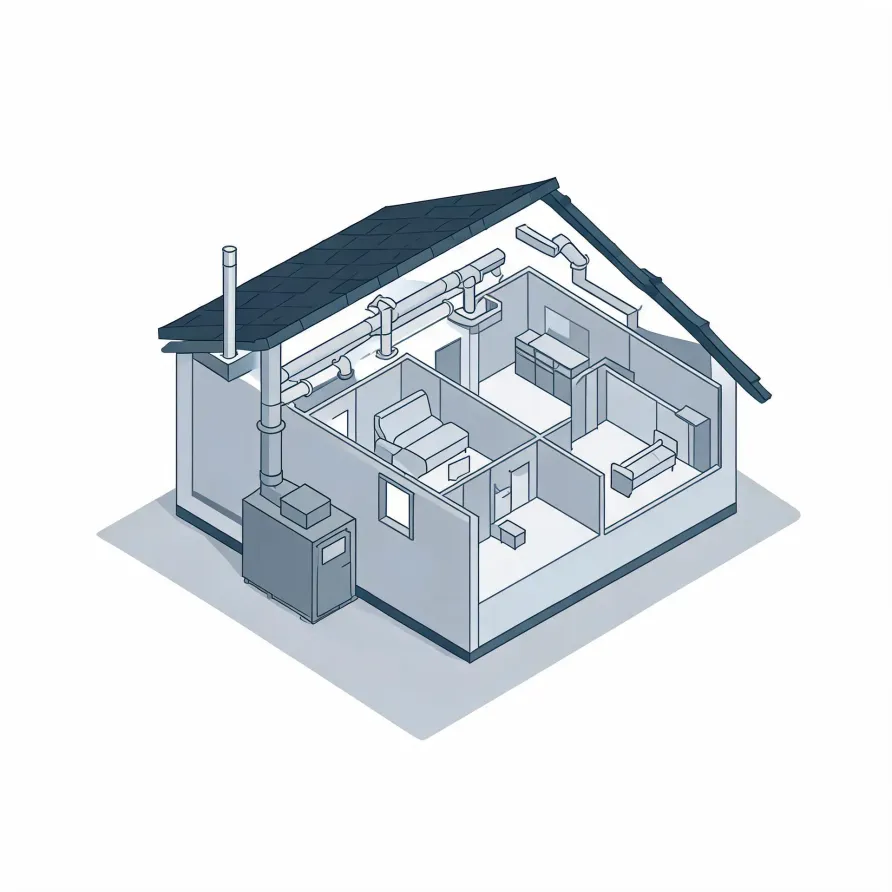
The furnace itself sits in a basement, utility room, or closet and is the unit a homeowner is most likely to recognize on sight. Inside it, a heat exchanger warms the air that moves through the house, and a blower motor pushes that air into the supply ducts. A flue pipe runs from the furnace to an exterior wall or up through the roof, carrying combustion exhaust out of the house.
The thermostat goes on an interior wall and is the control point for the whole system. A contractor also installs a gas line connection at the furnace and fits a condensate drain on high-efficiency models, which produce moisture as a byproduct and need a path to clear it.
The drawing shows a typical layout, and a licensed contractor determines exactly which components apply to your house and how they connect.
Get matched in Fayette CountyFayette County, Iowa, by the numbers
97 severe weather events were recorded in Fayette County, Iowa between 2015 and 2024.
NOAA National Centers for Environmental Information, Storm Events Database, bulk CSV export, events 2015-01-01 through 2024-12-31.Half the homes in Fayette County, Iowa were built in 1954 or earlier (2020-2024 ACS 5-year).
U.S. Census Bureau, 2020-2024 American Community Survey 5-Year EstimatesFayette County, Iowa holds 9,320 housing units (2020-2024 ACS 5-year).
U.S. Census Bureau, 2020-2024 American Community Survey 5-Year EstimatesOwners occupy 76.5% of the occupied homes in Fayette County, Iowa (2020-2024 ACS 5-year).
U.S. Census Bureau, 2020-2024 American Community Survey 5-Year EstimatesFurnace Installation Rules for Fayette County, Iowa5 codes & standards
What happens on installation day
Non-weatherized gas furnaces manufactured on or after November 19, 2015 must reach 80.0 percent AFUE.
Non-weatherized oil-fired furnaces manufactured on or after November 19, 2015 must reach 83.0 percent AFUE.
Mobile home gas furnaces manufactured on or after November 19, 2015 must reach 80.0 percent AFUE.
Non-weatherized gas furnaces manufactured on or after December 18, 2028 must reach 95.0 percent AFUE, up from the 80.0 percent minimum that applies to units manufactured before that date.
What Fayette County, Iowa Requires for HVAC Work
Iowa requires a state licence to install or repair HVAC, refrigeration, mechanical or plumbing systems, and to operate as a contractor, with exceptions listed in section 105.11.
Severe Weather Events in Fayette County
Weather places real demands on heating equipment, and those demands vary by where you are. A furnace sized and installed for Fayette County's climate will work harder or easier depending on what this area actually delivers year to year.
97 severe weather events, 2015–2024. Source: NOAA National Centers for Environmental Information, Storm Events Database.