Tell us about the job
Takes about a minute. No obligation.
A furnace running through years of severe weather accumulates wear in specific places: heat exchangers cycle harder, pressure switches get tripped repeatedly, and ignition components fatigue faster than a lab spec suggests. 136 severe weather events were recorded in Plymouth County, Iowa between 2015 and 2024. At that rate, a contractor diagnosing a failed part here has to sort out whether the failure came from age and neglect or from a system that has genuinely been worked hard by the climate. Those are different repairs. One calls for a targeted fix; the other points toward a broader inspection before parts get ordered.
Ductwork and heat exchangers in a furnace pulled from housing this old have often outlasted the part numbers they were built around. Half the homes in Plymouth County, Iowa were built in 1971 or earlier (2020-2024 ACS 5-year). When a contractor opens a furnace here, the first question is whether the failed component still has a supply chain behind it. Obsolete heat exchangers, discontinued igniter assemblies, and control boards no longer in production push a repair toward a decision that has nothing to do with the furnace's mechanical condition and everything to do with what a supplier can still ship.
The Parts of a Furnace a Contractor Checks First
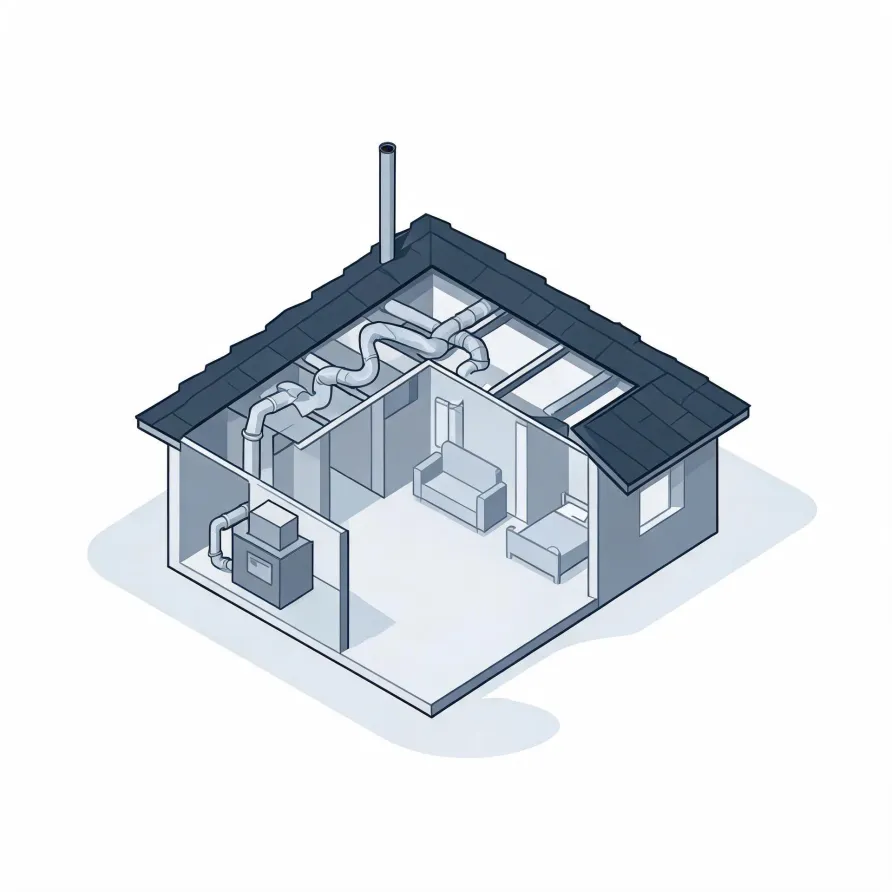
The furnace itself sits in a utility space, basement, or closet and is the unit a contractor opens first. Inside it, the heat exchanger and burner assembly are the pieces most likely behind a heating failure. The blower motor, housed in the lower cabinet, pulls air across the heat exchanger and pushes it into the supply side of your duct system.
The flue pipe runs from the furnace up and out of the house, carrying combustion gases away. Alongside it, the igniter and flame sensor work together to start and confirm a burner cycle. The control board ties these parts together, and a fault in any one of them can stop the whole system or send it into a lockout cycle.
The drawing shows a typical furnace layout, and a licensed contractor determines which components apply and what condition they are in for your specific home.
Get matched in Plymouth CountyPlymouth County, Iowa, by the numbers
136 severe weather events were recorded in Plymouth County, Iowa between 2015 and 2024.
NOAA National Centers for Environmental Information, Storm Events Database, bulk CSV export, events 2015-01-01 through 2024-12-31.Half the homes in Plymouth County, Iowa were built in 1971 or earlier (2020-2024 ACS 5-year).
U.S. Census Bureau, 2020-2024 American Community Survey 5-Year EstimatesPlymouth County, Iowa holds 10,891 housing units (2020-2024 ACS 5-year).
U.S. Census Bureau, 2020-2024 American Community Survey 5-Year EstimatesOwners occupy 73.6% of the occupied homes in Plymouth County, Iowa (2020-2024 ACS 5-year).
U.S. Census Bureau, 2020-2024 American Community Survey 5-Year EstimatesFurnace Repair Rules on the Books for Plymouth County, Iowa5 codes, standards & laws
What the repair visit looks like
Non-weatherized gas furnaces manufactured on or after November 19, 2015 must reach 80.0 percent AFUE.
Non-weatherized oil-fired furnaces manufactured on or after November 19, 2015 must reach 83.0 percent AFUE.
Mobile home gas furnaces manufactured on or after November 19, 2015 must reach 80.0 percent AFUE.
Non-weatherized gas furnaces manufactured on or after December 18, 2028 must reach 95.0 percent AFUE, up from the 80.0 percent minimum that applies to units manufactured before that date.
Licensing and Legal Requirements in Plymouth County, Iowa
Iowa requires a state licence to install or repair HVAC, refrigeration, mechanical or plumbing systems, and to operate as a contractor, with exceptions listed in section 105.11.
Severe Weather Events in Plymouth County
Hard weather puts real stress on heating equipment: sudden cold snaps, power fluctuations, and pressure swings all add to the load a furnace carries over its life. How much of that a system in Plymouth County has faced shapes what kind of repair work it needs and how soon.
136 severe weather events, 2015–2024. Source: NOAA National Centers for Environmental Information, Storm Events Database.