Tell us about the job
Takes about a minute. No obligation.
A furnace going into a Linn County home carries a real operating load from its first winter. 344 severe weather events were recorded in Linn County, Iowa between 2015 and 2024. At that rate, severe weather is a routine part of what the equipment lives in, and a contractor sizing a new furnace here has to account for that before settling on equipment. A unit undersized or poorly sealed will run against that load in ways a catalog spec does not predict. Getting the install right from the start is the work a contractor in this county is actually doing.
Existing ductwork is what a furnace installation in Linn County turns on. Half the homes in Linn County, Iowa were built in 1978 or earlier (2020-2024 ACS 5-year). Ducts laid down in housing that old were sized for equipment that moved air differently than a modern furnace does, and a contractor has to establish whether those runs can handle what a new unit delivers before the equipment itself becomes the question. Electrical service in the same houses gets the same check. A mismatch in either one changes the scope of the job.
What Gets Installed With a New Furnace
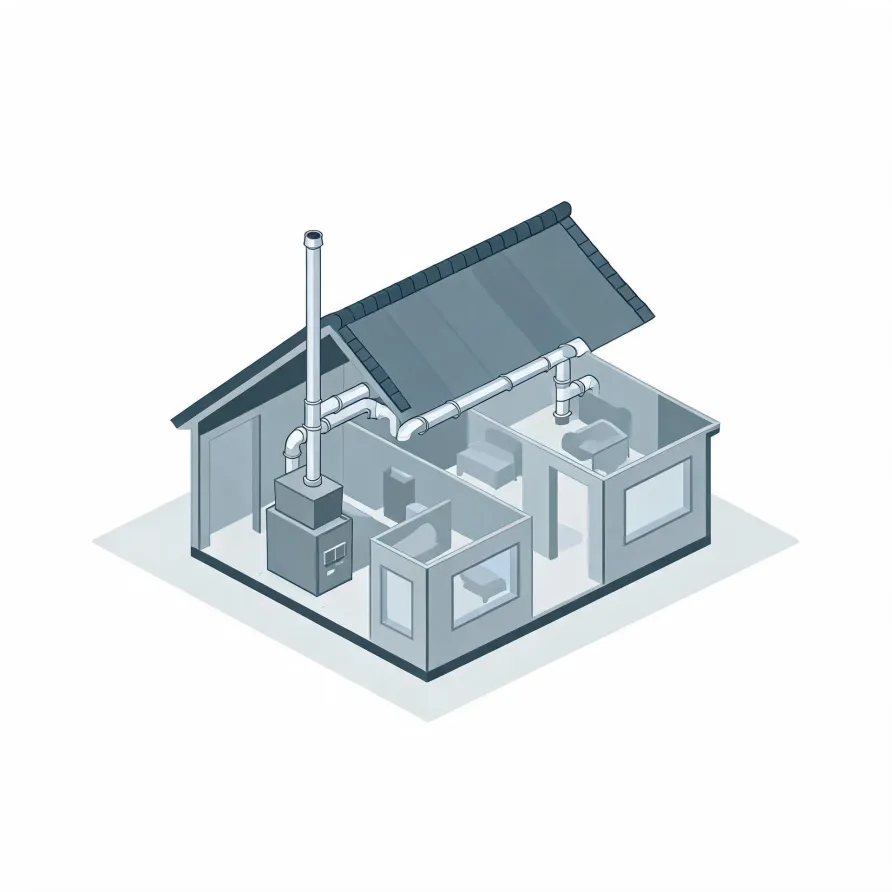
The furnace itself sits in a utility space, basement, or closet at the center of the system. A gas valve and burner assembly inside it produce heat, and a heat exchanger transfers that heat to the air moving through the unit. A blower motor then pushes the warmed air out into the home.
A flue pipe runs from the furnace to an exterior vent, carrying combustion gases out of the house. Beside the furnace, a thermostat mounted on a living-area wall acts as the control point, telling the system when to fire and when to stop.
The drawing shows a typical layout, and a licensed contractor determines exactly what applies to your house.
Get matched in Linn CountyLinn County, Iowa, by the numbers
344 severe weather events were recorded in Linn County, Iowa between 2015 and 2024.
NOAA National Centers for Environmental Information, Storm Events Database, bulk CSV export, events 2015-01-01 through 2024-12-31.Half the homes in Linn County, Iowa were built in 1978 or earlier (2020-2024 ACS 5-year).
U.S. Census Bureau, 2020-2024 American Community Survey 5-Year EstimatesLinn County, Iowa holds 103,104 housing units (2020-2024 ACS 5-year).
U.S. Census Bureau, 2020-2024 American Community Survey 5-Year EstimatesOwners occupy 73.5% of the occupied homes in Linn County, Iowa (2020-2024 ACS 5-year).
U.S. Census Bureau, 2020-2024 American Community Survey 5-Year EstimatesFurnace Installation Rules on the Books for Linn County, Iowa5 codes & standards
What the installation looks like from your side
Non-weatherized gas furnaces manufactured on or after November 19, 2015 must reach 80.0 percent AFUE.
Non-weatherized oil-fired furnaces manufactured on or after November 19, 2015 must reach 83.0 percent AFUE.
Mobile home gas furnaces manufactured on or after November 19, 2015 must reach 80.0 percent AFUE.
Non-weatherized gas furnaces manufactured on or after December 18, 2028 must reach 95.0 percent AFUE, up from the 80.0 percent minimum that applies to units manufactured before that date.
Licensing and Legal Requirements in Linn County, Iowa
Iowa requires a state licence to install or repair HVAC, refrigeration, mechanical or plumbing systems, and to operate as a contractor, with exceptions listed in section 105.11.
Severe Weather Events in Linn County
Weather in Linn County puts real demands on heating equipment, from the strain of deep cold snaps to the recovery load after sharp swings in temperature. A furnace sized and installed for local conditions handles those demands differently than one spec'd for somewhere milder.
344 severe weather events, 2015–2024. Source: NOAA National Centers for Environmental Information, Storm Events Database.