Tell us about the job
Takes about a minute. No obligation.
Sizing a furnace for a Clay County home starts with what the climate actually demands, not what a catalog says works for a house of that square footage. 141 severe weather events were recorded in Clay County, Iowa between 2015 and 2024. At that rate of events, a system here cycles hard through heating seasons that push equipment to its limits repeatedly, and a contractor quoting an install has to account for what those conditions ask of the heat exchanger and the blower over years. A unit undersized or loosely installed will lose efficiency faster than the manufacturer's numbers predict.
Ductwork in a house carries its original design assumptions forward, and in Clay County those assumptions are old ones. Half the homes in Clay County, Iowa were built in 1967 or earlier (2020-2024 ACS 5-year). A new furnace drops into a system that was planned for something different, and whether the existing runs, trunk lines, and returns can handle what the new unit moves is the question a contractor has to answer before the equipment selection matters. Electrical service gets the same look. A house of that vintage may be running on a panel that was expanded piecemeal over the decades, and what a modern furnace requires on a dedicated circuit is not the same calculation the original wiring was built for.
What Gets Installed With a New Furnace
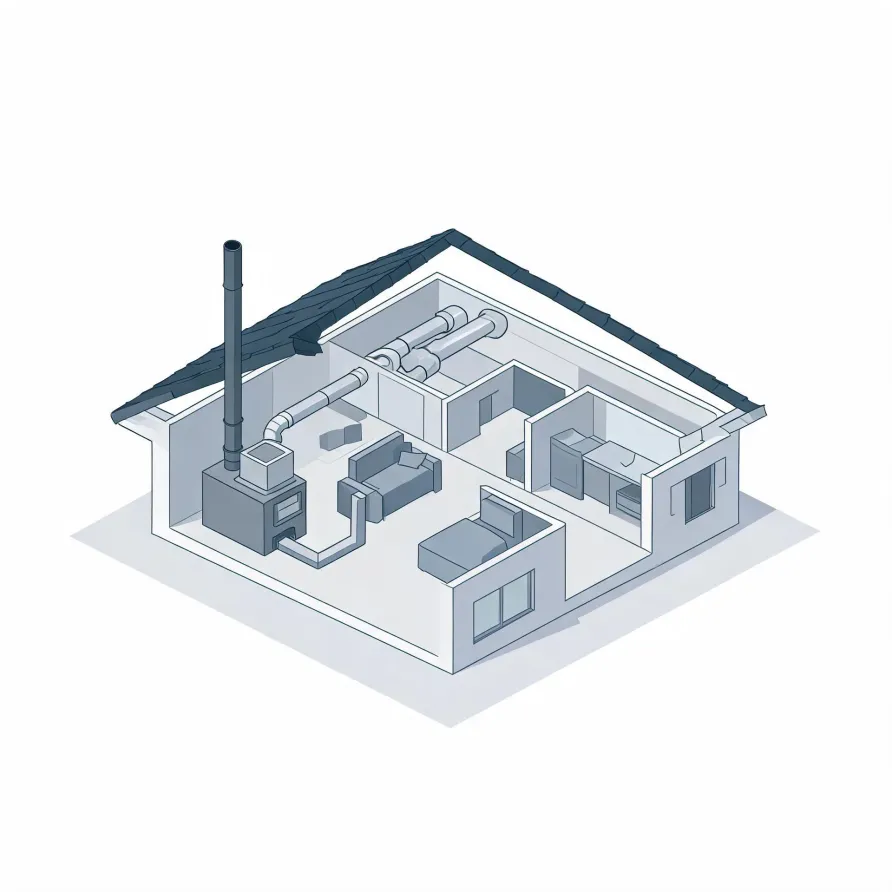
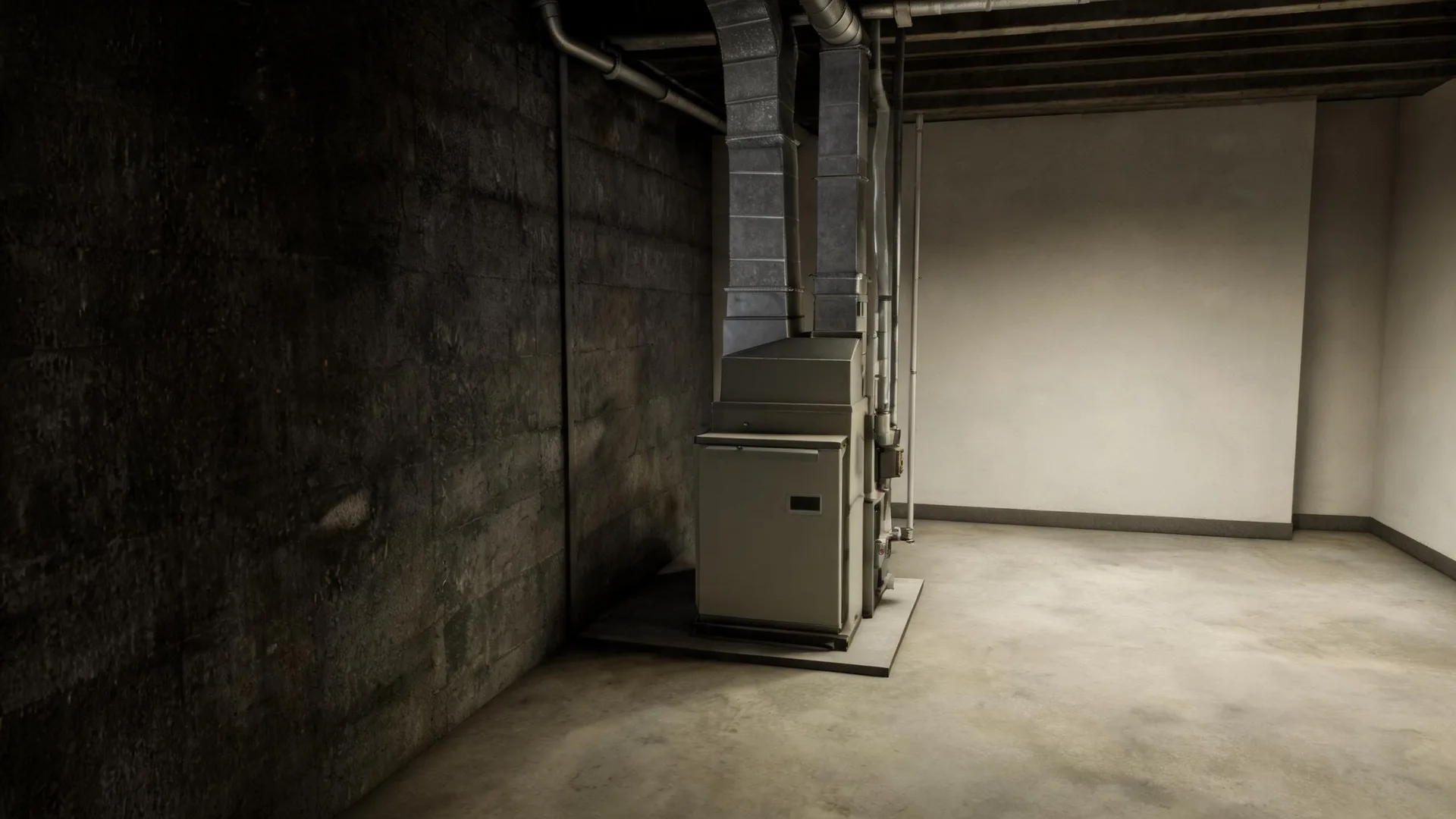
The furnace itself sits in a utility space, basement, or closet and is the unit that generates heat. A flue pipe runs from the furnace to an exterior wall or roof, carrying combustion gases out of the house. The thermostat mounts on an interior wall and is the control point the household interacts with daily.
The air handler, where present, sits alongside or above the furnace and moves conditioned air into the duct system. A filter housing connects to the return side of that assembly, and a condensate drain line runs to a floor drain or utility sink if the furnace is a high-efficiency model that produces moisture.
The drawing shows a representative layout, and a licensed contractor determines exactly what applies to this house based on its construction and existing equipment.
Get matched in Clay CountyClay County, Iowa, by the numbers
141 severe weather events were recorded in Clay County, Iowa between 2015 and 2024.
NOAA National Centers for Environmental Information, Storm Events Database, bulk CSV export, events 2015-01-01 through 2024-12-31.Half the homes in Clay County, Iowa were built in 1967 or earlier (2020-2024 ACS 5-year).
U.S. Census Bureau, 2020-2024 American Community Survey 5-Year EstimatesClay County, Iowa holds 8,157 housing units (2020-2024 ACS 5-year).
U.S. Census Bureau, 2020-2024 American Community Survey 5-Year EstimatesOwners occupy 73.3% of the occupied homes in Clay County, Iowa (2020-2024 ACS 5-year).
U.S. Census Bureau, 2020-2024 American Community Survey 5-Year EstimatesFurnace Installation Rules for Clay County, Iowa5 sourced standards and codes
What the installation actually looks like
Non-weatherized gas furnaces manufactured on or after November 19, 2015 must reach 80.0 percent AFUE.
Non-weatherized oil-fired furnaces manufactured on or after November 19, 2015 must reach 83.0 percent AFUE.
Mobile home gas furnaces manufactured on or after November 19, 2015 must reach 80.0 percent AFUE.
Non-weatherized gas furnaces manufactured on or after December 18, 2028 must reach 95.0 percent AFUE, up from the 80.0 percent minimum that applies to units manufactured before that date.
Licensing and Legal Requirements in Clay County, Iowa
Iowa requires a state licence to install or repair HVAC, refrigeration, mechanical or plumbing systems, and to operate as a contractor, with exceptions listed in section 105.11.
Severe Weather Events in Clay County
Clay County's weather puts real demands on heating equipment, and those demands shape what a furnace installation here needs to handle. Sizing and equipment choices are local decisions because the climate conditions are local.
141 severe weather events, 2015–2024. Source: NOAA National Centers for Environmental Information, Storm Events Database.