Tell us about the job
Takes about a minute. No obligation.
A contractor diagnosing a furnace in Lee County starts with the system's service history, not the calendar, because the weather load here lands in a range where age and neglected maintenance account for most failures. 142 severe weather events were recorded in Lee County, Iowa between 2015 and 2024. At that rate, severe weather is a real but occasional pressure on equipment, not the grinding seasonal force that wears components to failure on its own. A furnace that has been cleaned, filtered, and serviced regularly will run through the weather this county sees without surrendering a heat exchanger or a control board ahead of schedule. When a contractor opens a unit and finds cracked components or a failed inducer motor, deferred maintenance is the likelier explanation, and the repair scope follows from that.
Ductwork in a house like this has seen at least one furnace come and go, maybe more. Half the homes in Lee County, Iowa were built in 1960 or earlier (2020-2024 ACS 5-year). That history matters for repair work because a system that has been swapped in and adapted over the years may be running components whose replacement parts are no longer in regular production. A contractor who opens the unit is checking the condition of what is inside, but also whether what is worn or failed can actually be sourced. If it can, the repair is priced and scheduled. If the part is discontinued or available only through specialty suppliers, that changes both the timeline and what the contractor recommends.
The Parts of a Furnace a Contractor Checks First
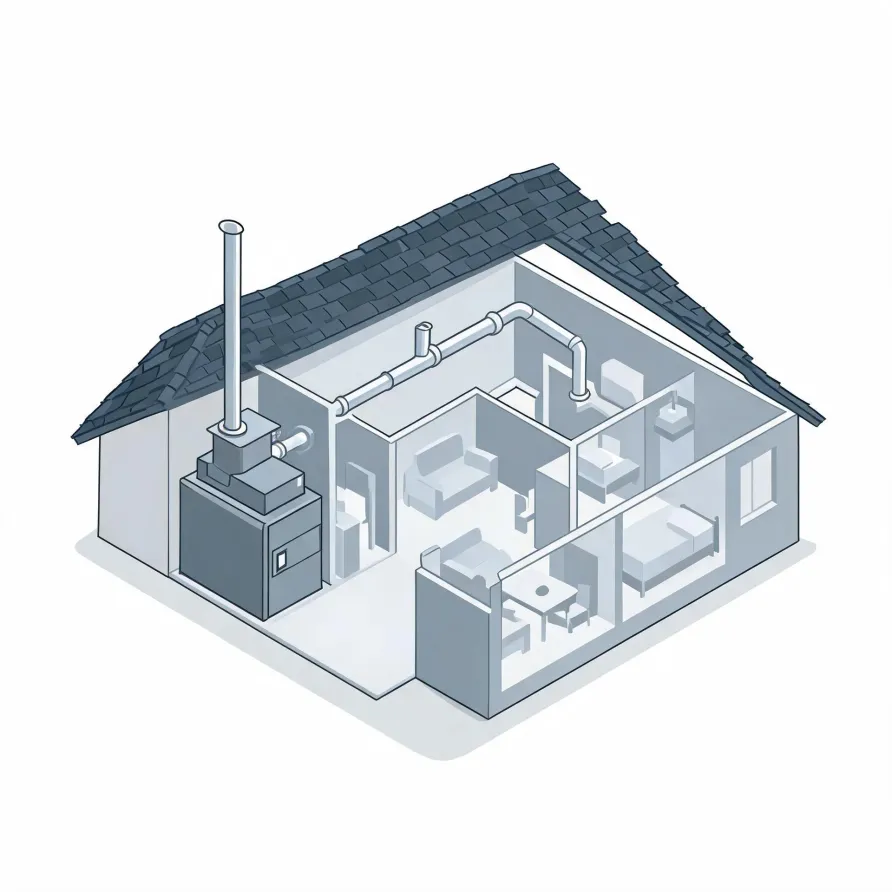
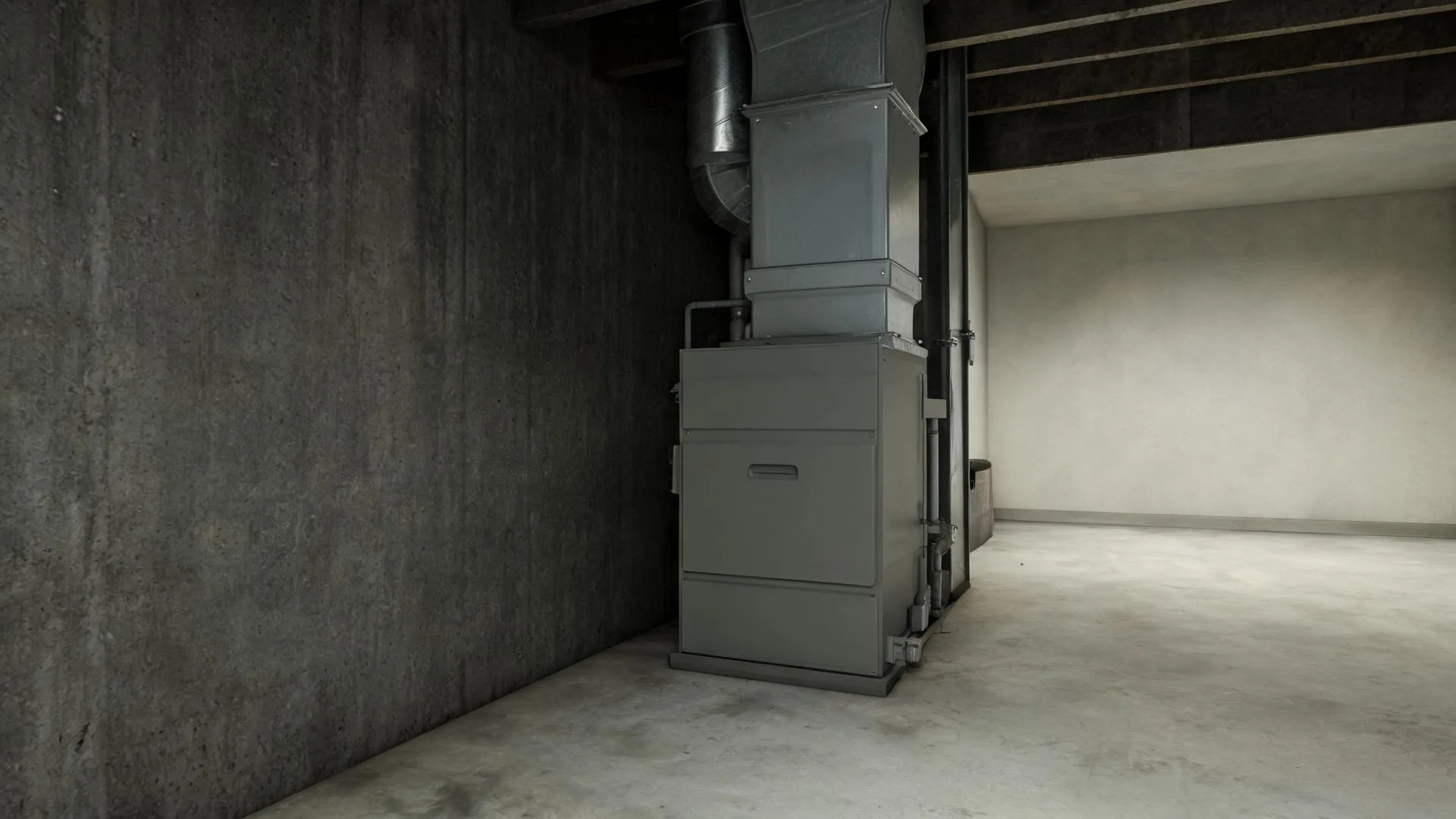
The furnace itself sits in a mechanical room, basement, or utility closet and is the piece a contractor looks at most closely during a repair call. Inside it, the heat exchanger, burners, and blower motor each have a distinct job, and a fault in any one of them shows up differently. A cracked heat exchanger, a burner that won't light, and a blower that runs but moves little air each point a contractor in a different direction.
The flue pipe carries combustion gases out of the house and connects the furnace to the outside, so a contractor checks it for blockages or damage that could push those gases back in. The thermostat and the control board sit apart from the furnace itself but talk to it constantly, and either one can be the reason a furnace behaves erratically or won't start at all.
The drawing shows the general layout of a furnace system, and a licensed contractor determines which components and conditions apply to your specific house.
Get matched in Lee CountyLee County, Iowa, by the numbers
142 severe weather events were recorded in Lee County, Iowa between 2015 and 2024.
NOAA National Centers for Environmental Information, Storm Events Database, bulk CSV export, events 2015-01-01 through 2024-12-31.Half the homes in Lee County, Iowa were built in 1960 or earlier (2020-2024 ACS 5-year).
U.S. Census Bureau, 2020-2024 American Community Survey 5-Year EstimatesLee County, Iowa holds 15,794 housing units (2020-2024 ACS 5-year).
U.S. Census Bureau, 2020-2024 American Community Survey 5-Year EstimatesOwners occupy 76.3% of the occupied homes in Lee County, Iowa (2020-2024 ACS 5-year).
U.S. Census Bureau, 2020-2024 American Community Survey 5-Year EstimatesFurnace Repair Rules on Record for Lee County, Iowa5 codes, standards & laws
What the repair visit looks like
Non-weatherized gas furnaces manufactured on or after November 19, 2015 must reach 80.0 percent AFUE.
Non-weatherized oil-fired furnaces manufactured on or after November 19, 2015 must reach 83.0 percent AFUE.
Mobile home gas furnaces manufactured on or after November 19, 2015 must reach 80.0 percent AFUE.
Non-weatherized gas furnaces manufactured on or after December 18, 2028 must reach 95.0 percent AFUE, up from the 80.0 percent minimum that applies to units manufactured before that date.
Licensing and Legal Requirements in Lee County, Iowa
Iowa requires a state licence to install or repair HVAC, refrigeration, mechanical or plumbing systems, and to operate as a contractor, with exceptions listed in section 105.11.
Severe Weather Events in Lee County
Weather puts real strain on heating equipment. Hard conditions accelerate wear, and furnaces in Lee County face whatever the local climate delivers, which is why repair demand here is tied to what happens outside.
142 severe weather events, 2015–2024. Source: NOAA National Centers for Environmental Information, Storm Events Database.