Tell us about the job
Takes about a minute. No obligation.
A contractor quoting a furnace repair in Ida County starts by ruling out the mundane causes: a heat exchanger that has simply worn through, a control board that never got a cleaning, an inducer motor running on borrowed time. 91 severe weather events were recorded in Ida County, Iowa between 2015 and 2024. At roughly the national midpoint for severe weather, the area does not put equipment through the kind of sustained load that reshuffles the usual order of failure. That means the diagnosis tends to land on installation quality and service history before it lands anywhere else, and a contractor who skips that check leaves the actual cause unfixed.
Half the homes in Ida County, Iowa were built in 1952 or earlier (2020-2024 ACS 5-year). A furnace sitting in a house that old was almost certainly put in well after the walls went up, which means the building's age and the equipment's age are separate questions. When a contractor opens the unit on a repair call, what matters is what that specific system turns out to be: the manufacturer, the heat exchanger condition, and whether replacement components are still in production. A house built before mid-century gives no reliable answer to any of those.
The Parts of a Furnace a Contractor Checks First
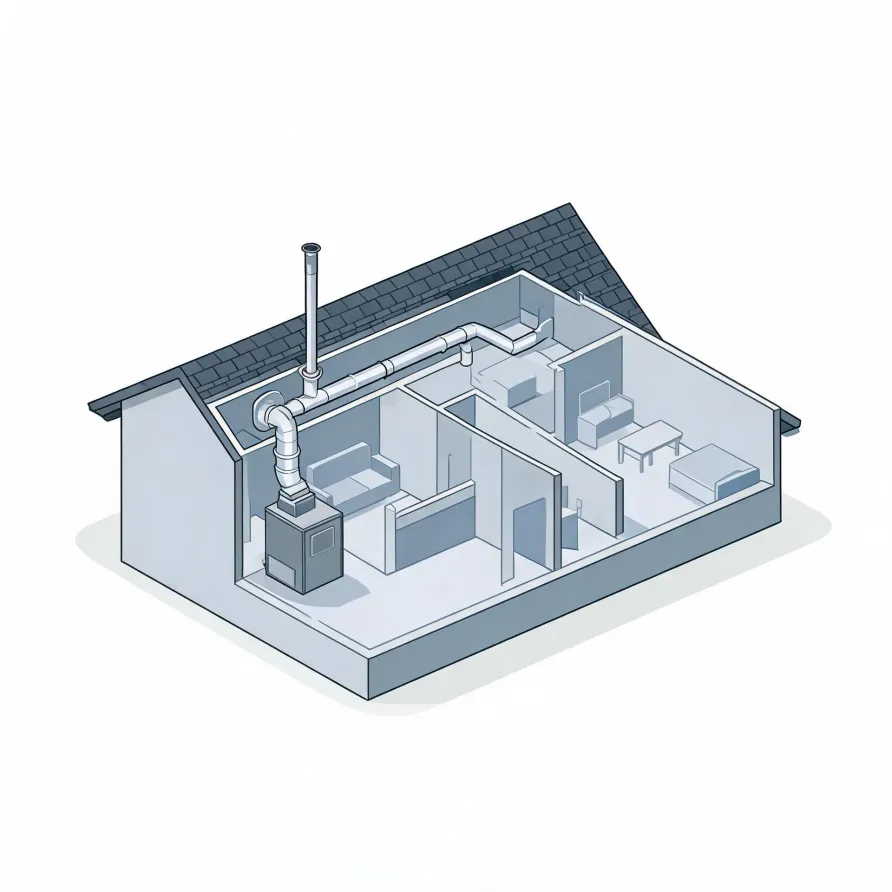
The furnace itself sits in the basement, utility room, or closet and is the heart of the system. Inside it, the heat exchanger is the piece a contractor goes to early when something is wrong. Cracks or failures there let combustion gases into the airstream, so it draws close attention. The burners, which fire inside that exchanger, are checked when the system runs poorly or fails to light.
The blower motor pulls air through the system and pushes conditioned air into the supply side. When a furnace runs but no air moves, that motor is the likely starting point. Alongside it sits the control board, which tells every other component when and how to operate. The flue and heat exchanger connections are also visible to a contractor working in that space.
The drawing shows the general layout of a furnace system, and a licensed contractor determines which components and conditions apply to your particular house.
Get matched in Ida CountyIda County, Iowa, by the numbers
91 severe weather events were recorded in Ida County, Iowa between 2015 and 2024.
NOAA National Centers for Environmental Information, Storm Events Database, bulk CSV export, events 2015-01-01 through 2024-12-31.Half the homes in Ida County, Iowa were built in 1952 or earlier (2020-2024 ACS 5-year).
U.S. Census Bureau, 2020-2024 American Community Survey 5-Year EstimatesIda County, Iowa holds 3,369 housing units (2020-2024 ACS 5-year).
U.S. Census Bureau, 2020-2024 American Community Survey 5-Year EstimatesOwners occupy 72.9% of the occupied homes in Ida County, Iowa (2020-2024 ACS 5-year).
U.S. Census Bureau, 2020-2024 American Community Survey 5-Year EstimatesCodes & Standards for Furnace Repair in Ida County, Iowa5 sourced rules & standards
What the Repair Visit Looks Like
Non-weatherized gas furnaces manufactured on or after November 19, 2015 must reach 80.0 percent AFUE.
Non-weatherized oil-fired furnaces manufactured on or after November 19, 2015 must reach 83.0 percent AFUE.
Mobile home gas furnaces manufactured on or after November 19, 2015 must reach 80.0 percent AFUE.
Non-weatherized gas furnaces manufactured on or after December 18, 2028 must reach 95.0 percent AFUE, up from the 80.0 percent minimum that applies to units manufactured before that date.
What Ida County, Iowa Requires for HVAC Repair
Iowa requires a state licence to install or repair HVAC, refrigeration, mechanical or plumbing systems, and to operate as a contractor, with exceptions listed in section 105.11.
Severe Weather Events in Ida County
Weather in this part of Iowa puts real hours on heating equipment. How hard a furnace works over its life is largely a function of what the local climate demands, and that demand shows up in the repair record.
91 severe weather events, 2015–2024. Source: NOAA National Centers for Environmental Information, Storm Events Database.