Tell us about the job
Takes about a minute. No obligation.
A furnace that has been running in Delaware County has been doing it against weather that presses the system hard enough to matter. 105 severe weather events were recorded in Delaware County, Iowa between 2015 and 2024. At that rate, a contractor looking at a failed heat exchanger or a cracked burner assembly cannot assume age is the whole story. They have to work out whether the failure pattern points to accumulated load or to a part that was already marginal. That distinction changes what gets replaced and what gets left alone.
Furnaces in Delaware County houses that predate modern equipment lines carry part numbers that manufacturers retired long before the current repair catalogs were printed. Half the homes in Delaware County, Iowa were built in 1967 or earlier (2020-2024 ACS 5-year). When a contractor opens a unit in stock like this, the question that shapes the job is whether the components it takes are still being made, or whether sourcing them means hunting through secondary suppliers and extending the timeline. A heat exchanger or a control board that looks repairable can become a replacement decision the moment the part turns out to be discontinued.
The Parts of a Furnace a Contractor Checks First
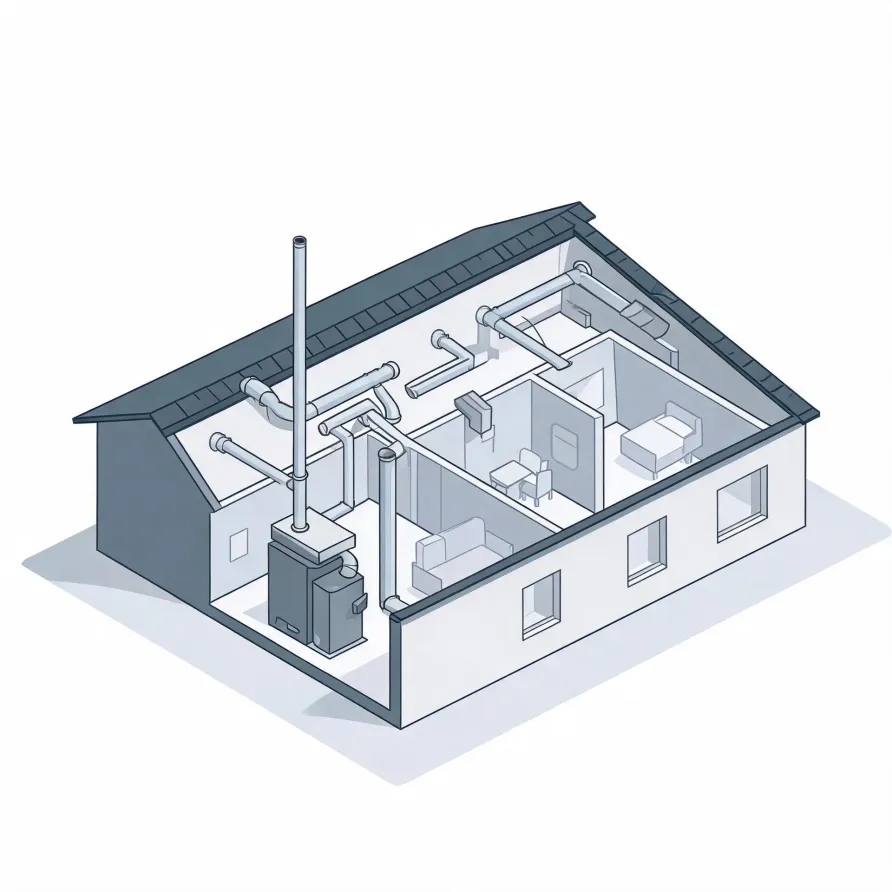
The furnace itself sits in a mechanical room, basement, or utility closet and is the piece a contractor goes to immediately when heat stops working or runs wrong. Inside it, the heat exchanger is the part that fails quietly and matters most: cracks in it let combustion gases into living air, so it is one of the first things a contractor examines. The burners, which fire inside that exchanger, get checked for uneven flame or buildup that throws off the burn.
The blower motor moves conditioned air out through the supply side and sits inside the furnace cabinet, where a contractor can test it directly and inspect the belt or bearings if it is running loud or not at all. The flue pipe runs from the furnace to an exterior wall or roof and carries exhaust out of the house. The thermostat, mounted on an interior wall, is where a contractor often starts when a furnace runs short cycles or will not respond.
The drawing shows a typical layout, and a licensed contractor determines which components apply to your specific system and what work each one needs.
Get matched in Delaware CountyDelaware County, Iowa, by the numbers
105 severe weather events were recorded in Delaware County, Iowa between 2015 and 2024.
NOAA National Centers for Environmental Information, Storm Events Database, bulk CSV export, events 2015-01-01 through 2024-12-31.Half the homes in Delaware County, Iowa were built in 1967 or earlier (2020-2024 ACS 5-year).
U.S. Census Bureau, 2020-2024 American Community Survey 5-Year EstimatesDelaware County, Iowa holds 8,169 housing units (2020-2024 ACS 5-year).
U.S. Census Bureau, 2020-2024 American Community Survey 5-Year EstimatesOwners occupy 79.6% of the occupied homes in Delaware County, Iowa (2020-2024 ACS 5-year).
U.S. Census Bureau, 2020-2024 American Community Survey 5-Year EstimatesCodes & Standards Governing Furnace Repair in Delaware County, Iowa5 sourced rules and standards
What Happens When the Contractor Comes Out
Non-weatherized gas furnaces manufactured on or after November 19, 2015 must reach 80.0 percent AFUE.
Non-weatherized oil-fired furnaces manufactured on or after November 19, 2015 must reach 83.0 percent AFUE.
Mobile home gas furnaces manufactured on or after November 19, 2015 must reach 80.0 percent AFUE.
Non-weatherized gas furnaces manufactured on or after December 18, 2028 must reach 95.0 percent AFUE, up from the 80.0 percent minimum that applies to units manufactured before that date.
Licensing and Legal Requirements in Delaware County, Iowa
Iowa requires a state licence to install or repair HVAC, refrigeration, mechanical or plumbing systems, and to operate as a contractor, with exceptions listed in section 105.11.
Severe Weather Events in Delaware County
Furnaces in Delaware County work against whatever the climate puts on them, and years with heavy weather demand more from heating equipment than mild ones do. That load history is a local fact, which is why the record below belongs on a page about repair work here.
105 severe weather events, 2015–2024. Source: NOAA National Centers for Environmental Information, Storm Events Database.