Tell us about the job
Takes about a minute. No obligation.
A contractor quoting a furnace installation in Appanoose County has to account for what the heating load here actually demands, and the weather record is part of that picture. 88 severe weather events were recorded in Appanoose County, Iowa between 2015 and 2024. At roughly that rate, severe weather is a recurring factor in how equipment gets sized and specified here, not a rare edge case a contractor can ignore. A furnace undersized for this climate will cycle harder and wear faster than the specs suggest. That is why load calculations for this area need to reflect local conditions, and why a contractor who quotes from a catalog without adjusting for what this county sees regularly will leave a homeowner with a system that is always working harder than it should.
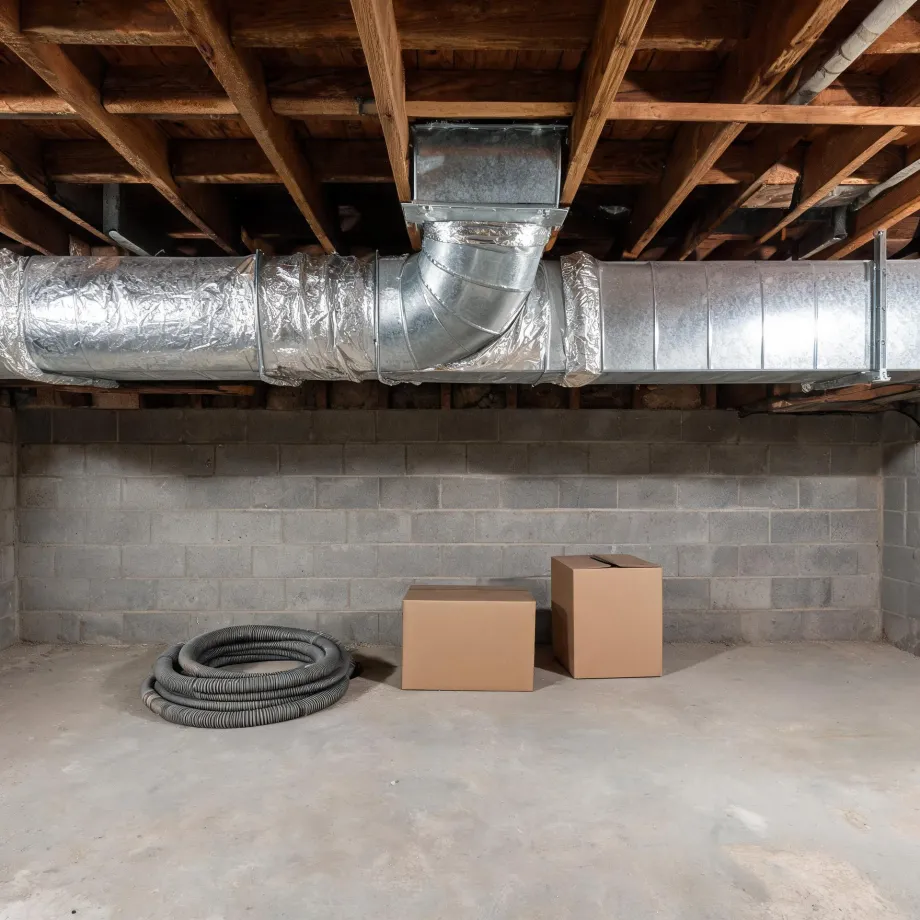
Ductwork sized and routed for the heating systems that came before modern furnaces is what shapes how a furnace installation goes in much of this county. Half the homes in Appanoose County, Iowa were built in 1964 or earlier (2020-2024 ACS 5-year). A contractor putting in a new furnace has to establish whether the existing duct runs will move the air volume the new unit expects, and whether the electrical service at the house will carry it. If the ductwork falls short, the install expands. That is the variable the house introduces, and it is the one a contractor works out before any equipment is ordered.
What Gets Installed With a New Furnace
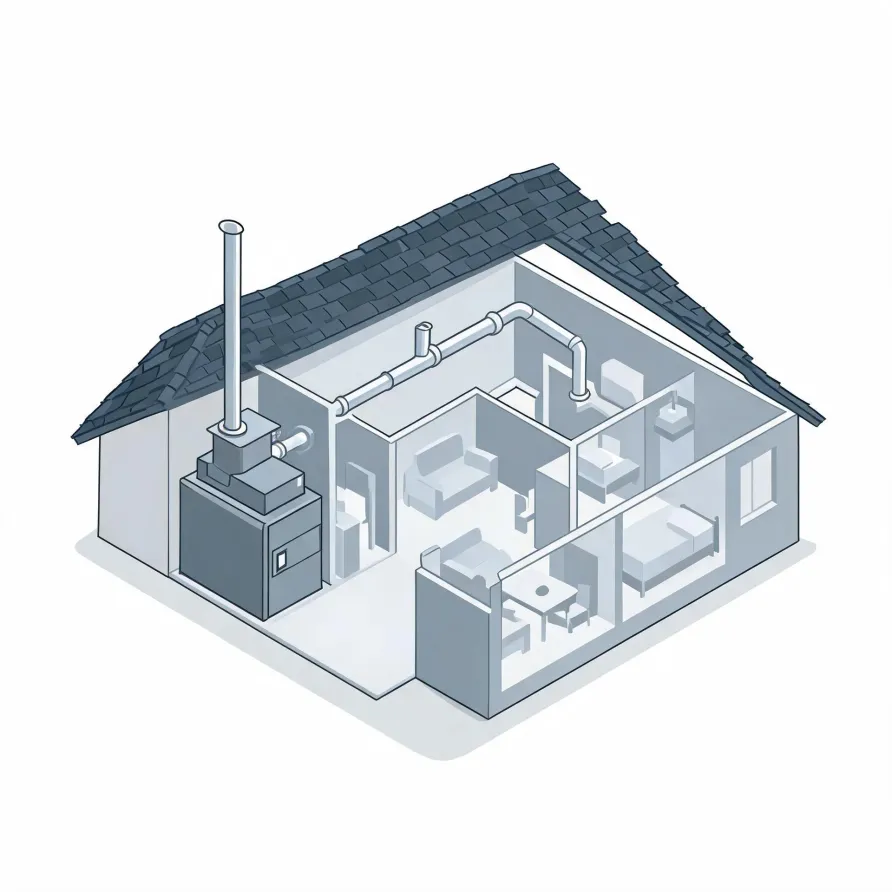
The furnace itself sits in a utility space, a basement, a closet, or a mechanical room, and it is the unit that generates heat for the whole house. Mounted on or near it is the air handler, which pulls return air across the heat exchanger and pushes conditioned air back through the supply side of the duct system.
The flue pipe runs from the furnace to an exterior termination point, carrying combustion exhaust safely out of the house. A thermostat goes on an interior wall where it reads the living space temperature and tells the furnace when to fire and when to shut off. A condensate drain line also connects to high-efficiency units, routing water vapor that condenses during the heating process to a floor drain or utility sink.
The drawing shows a representative layout, and a licensed contractor determines exactly what applies to this house's configuration.
Get matched in Appanoose CountyAppanoose County, by the numbers
88 severe weather events were recorded in Appanoose County, Iowa between 2015 and 2024.
NOAA National Centers for Environmental Information, Storm Events Database, bulk CSV export, events 2015-01-01 through 2024-12-31.Half the homes in Appanoose County, Iowa were built in 1964 or earlier (2020-2024 ACS 5-year).
U.S. Census Bureau, 2020-2024 American Community Survey 5-Year EstimatesAppanoose County, Iowa holds 6,312 housing units (2020-2024 ACS 5-year).
U.S. Census Bureau, 2020-2024 American Community Survey 5-Year EstimatesOwners occupy 68.8% of the occupied homes in Appanoose County, Iowa (2020-2024 ACS 5-year).
U.S. Census Bureau, 2020-2024 American Community Survey 5-Year EstimatesFurnace Installation Rules for Appanoose County, Iowa5 sourced standards and codes
What the Installation Actually Looks Like
Non-weatherized gas furnaces manufactured on or after November 19, 2015 must reach 80.0 percent AFUE.
Non-weatherized oil-fired furnaces manufactured on or after November 19, 2015 must reach 83.0 percent AFUE.
Mobile home gas furnaces manufactured on or after November 19, 2015 must reach 80.0 percent AFUE.
Non-weatherized gas furnaces manufactured on or after December 18, 2028 must reach 95.0 percent AFUE, up from the 80.0 percent minimum that applies to units manufactured before that date.
Licensing and Legal Requirements in Appanoose County, Iowa
Iowa requires a state licence to install or repair HVAC, refrigeration, mechanical or plumbing systems, and to operate as a contractor, with exceptions listed in section 105.11.
Severe Weather Events in Appanoose County
Appanoose County weather puts real demands on heating equipment, from hard winters that push furnaces to their limits to the kind of temperature swings that wear on systems over time. A furnace sized and installed for local conditions handles that load differently than one spec'd for somewhere else.
88 severe weather events, 2015–2024. Source: NOAA National Centers for Environmental Information, Storm Events Database.