Tell us about the job
Takes about a minute. No obligation.
A contractor diagnosing a furnace in Iowa County starts by ruling out the ordinary causes first: age, neglected filters, cracked heat exchangers, and worn igniters that have simply cycled past their limit. 100 severe weather events were recorded in Iowa County, Iowa between 2015 and 2024. That puts this county near the middle of the national distribution, which means severe weather is a real but not dominant factor in what fails. A furnace that stops heating in January is far more likely carrying years of deferred maintenance than it is bearing the mark of any particular storm season.
Furnace systems in stock this old have usually been swapped out at least once since the house was built, which means what a contractor finds when they open the unit is rarely what the permit history suggests. Half the homes in Iowa County, Iowa were built in 1969 or earlier (2020-2024 ACS 5-year). That gap between when the house was framed and what is running in it now is what makes parts availability the variable that shapes a repair here. A heat exchanger or control board from a mid-cycle replacement may sit in a line that a manufacturer has since discontinued, and a contractor who does not confirm supply before quoting can come back with a number that changes once they place the order.
The Parts of a Furnace a Contractor Checks First
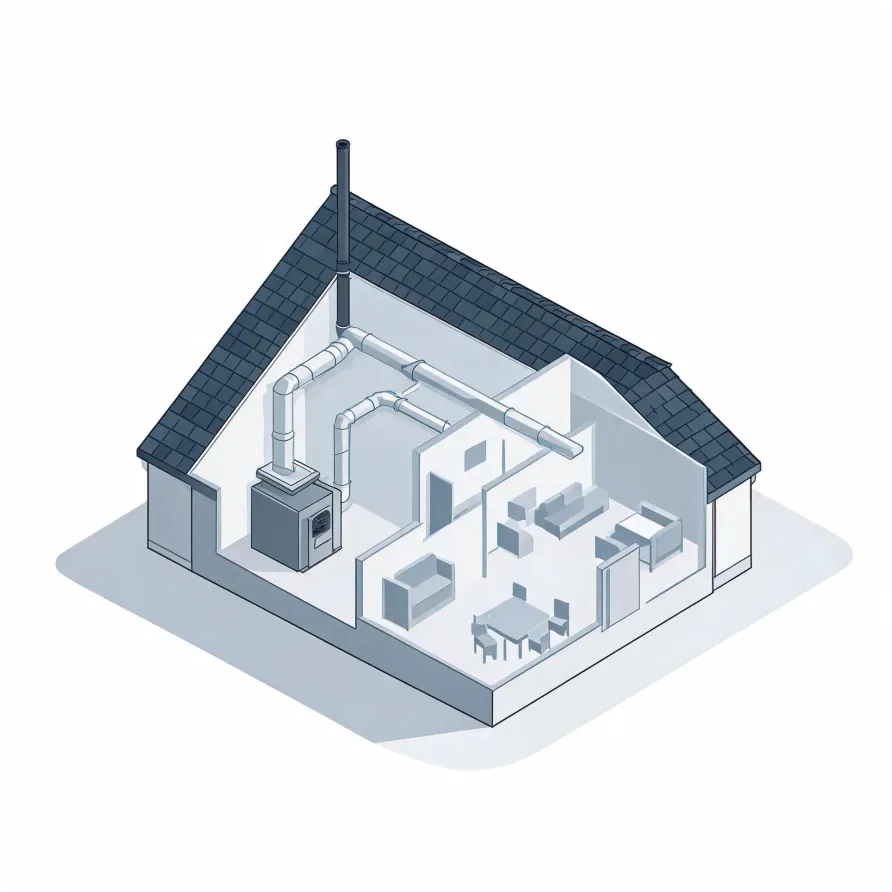
The furnace itself sits in a mechanical room, basement, or utility closet and is the heart of what a contractor examines. Inside it, the heat exchanger is the piece most worth understanding: when it cracks or corrodes, combustion gases can escape into living air. The burners, which fire beneath it, are another early stop when heat output is weak or uneven.
The blower motor sits at the base of the furnace cabinet and pushes conditioned air into the supply plenum above it. The flue pipe runs from the top of the cabinet out through a wall or roof and is checked when combustion gases back up or venting is poor. The thermostat on a main living-area wall is where a contractor often starts, since a wiring or calibration fault there can mimic a larger mechanical failure.
The drawing shows the general layout of a furnace system, and a licensed contractor determines which components apply and what work is needed in your specific home.
Get matched in Iowa CountyIowa County, Iowa, by the numbers
100 severe weather events were recorded in Iowa County, Iowa between 2015 and 2024.
NOAA National Centers for Environmental Information, Storm Events Database, bulk CSV export, events 2015-01-01 through 2024-12-31.Half the homes in Iowa County, Iowa were built in 1969 or earlier (2020-2024 ACS 5-year).
U.S. Census Bureau, 2020-2024 American Community Survey 5-Year EstimatesIowa County, Iowa holds 7,369 housing units (2020-2024 ACS 5-year).
U.S. Census Bureau, 2020-2024 American Community Survey 5-Year EstimatesOwners occupy 76.6% of the occupied homes in Iowa County, Iowa (2020-2024 ACS 5-year).
U.S. Census Bureau, 2020-2024 American Community Survey 5-Year EstimatesCodes & Standards Governing Furnace Repair in Iowa County, Iowa5 sourced rules and standards
What happens when a contractor comes out for HVAC repair in Iowa County
Non-weatherized gas furnaces manufactured on or after November 19, 2015 must reach 80.0 percent AFUE.
Non-weatherized oil-fired furnaces manufactured on or after November 19, 2015 must reach 83.0 percent AFUE.
Mobile home gas furnaces manufactured on or after November 19, 2015 must reach 80.0 percent AFUE.
Non-weatherized gas furnaces manufactured on or after December 18, 2028 must reach 95.0 percent AFUE, up from the 80.0 percent minimum that applies to units manufactured before that date.
Licensing and Legal Requirements in Iowa County, Iowa
Iowa requires a state licence to install or repair HVAC, refrigeration, mechanical or plumbing systems, and to operate as a contractor, with exceptions listed in section 105.11.
Weather Stress on HVAC Equipment in Iowa County
Heating equipment in Iowa County works against whatever the climate puts out, and that workload shapes how hard components run and how fast they wear. Repair demand here follows local weather patterns, which is why the county's storm record belongs on a page about furnace service.
100 severe weather events, 2015–2024. Source: NOAA National Centers for Environmental Information, Storm Events Database.